
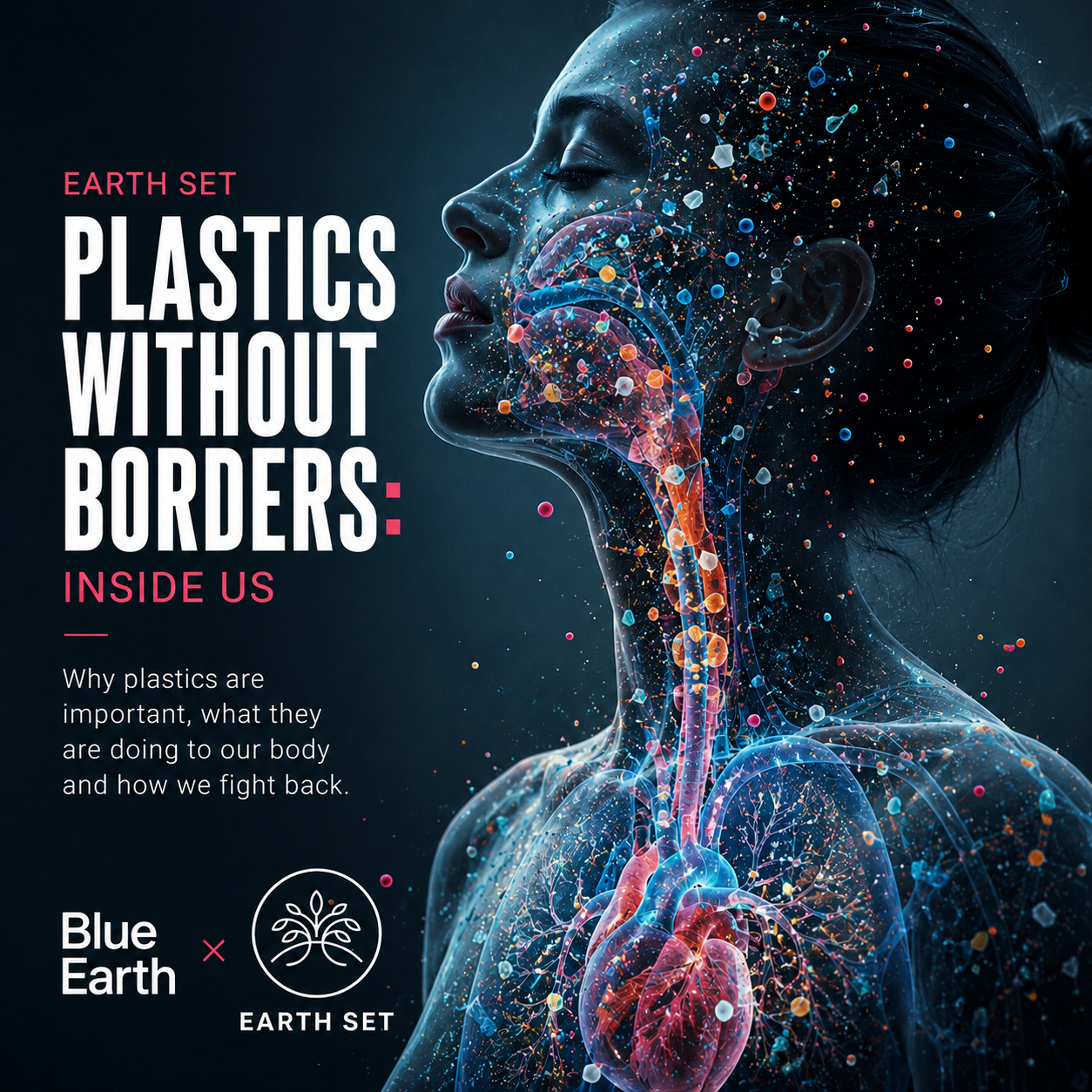
Plastics Without Borders: Inside Us
June 2026
Held in partnership with Blue Earth and SXSW London
Featuring Sian Sutherland (A Plastic Planet), Professor Richard Lea (University of Nottingham), Saabira Chaudhuri (author of Consumed), Laura Harnett (Seep) and Amir Afshar (Shellworks).
Venue: Mother London
For years, plastic pollution has been presented as an environmental problem.
The images are familiar: littered beaches, floating waste patches, seabirds and marine life harmed by discarded packaging. The proposed solutions have been equally familiar: recycle more, reduce consumption, improve waste management and encourage better consumer choices.
Yet despite decades of campaigns, regulations and recycling schemes, global plastic production continues to rise. This event explored a different perspective. What if plastics are not primarily a waste problem at all? What if the most important story is no longer what plastics are doing to the environment, but what they may be doing to us?
From Pollution "Out There" to Pollution "Inside Us"
Sian Sutherland, co-founder of A Plastic Planet and moderator of the event, argued that the plastics debate may be entering a new phase. For years, environmental campaigners have sought to draw attention to the visible impacts of plastic pollution. While those concerns remain important, they have not succeeded in slowing production. Plastic has become deeply embedded in modern economies, supply chains and daily life.
Increasingly, however, attention is turning towards human health. Microplastics and plastic-associated chemicals have now been detected in blood, placentas, breast milk and human tissue. The pollution is no longer somewhere else. It is inside us.
This shift sits behind A Plastic Planet's new Plastic Free Babies campaign, which focuses on reducing exposure during the first 1,000 days of life — from conception through early infancy — when many of the body's key systems are developing. The campaign, launching June 2026, reflects a growing belief that concern for children's health may ultimately prove a more powerful catalyst for change than concern about litter, recycling rates or marine pollution.
Understanding the Science
Professor Richard Lea of the University of Nottingham provided the scientific context behind many of these concerns. He focused particularly on endocrine-disrupting chemicals: substances capable of interfering with hormonal signalling systems that regulate growth, reproduction, metabolism and development.
As Professor Lea explained, studying these effects is inherently difficult. Human beings are exposed to multiple chemicals over long periods, often at very low doses and often in combination. Establishing direct causal links is therefore challenging.
Yet uncertainty should not be mistaken for ignorance. The scientific debate has increasingly moved beyond asking whether exposure occurs and towards understanding what the long-term consequences may be. Questions around fertility, reproductive health, neurological development and metabolic disease are all active areas of research.
How Plastics Conquered the Modern World
If the science explains the concern, history helps explain how we arrived here. Saabira Chaudhuri, journalist and author of Consumed, reminded the audience that plastics became dominant for good reasons.
The post-war decades saw enormous social and economic change. More women entered the workforce, households became busier, supermarkets expanded and consumers increasingly valued convenience. Plastics enabled many of these developments.
Modern food retailing, in particular, became deeply dependent on plastic packaging. Pre-packaged produce, ready-prepared foods and the supermarket model familiar today would have been far more difficult without lightweight, cheap and versatile plastic materials.
This is one reason why the problem has proved so difficult to solve. as plastics are not simply a product category that can be swapped for something else. They have become woven into the infrastructure of modern life. Entire industries, supply chains and business models have developed around assumptions of abundant, low-cost plastic materials. The challenge is therefore far larger than replacing a few disposable items.
Building Alternatives
Laura Harnett, founder of Seep, described the challenge of removing plastic from some of the most ordinary products in our homes. Cleaning sponges, cloths, scourers and household essentials are often made from virgin plastic, used briefly and then discarded. Seep was founded to offer alternatives made from natural and renewable materials, demonstrating that products many people never think about can be redesigned with significantly less plastic.
Amir Afshar of Shellworks tackled the issue from a different angle. Rather than simply reducing plastic use, Shellworks is developing entirely new materials designed to replace conventional fossil-fuel-derived plastics. Drawing on natural polymers, the company is creating packaging and products that can deliver the functionality consumers and businesses expect without relying on traditional plastic chemistry.
Together, the two speakers highlighted both the opportunity and the challenge. Consumers increasingly want alternatives, but those alternatives must still be affordable, scalable, attractive and easy to use. The barriers are not simply technological. They are economic, behavioural and political as well. Yet both companies offered tangible examples of how innovation is beginning to reshape one of the most plastic-intensive parts of modern life.
A New Chapter in the Plastics Debate
Perhaps the most striking conclusion from the evening was how much the plastics conversation has evolved. Environmental concerns remain important, but the centre of gravity appears to be shifting. Increasingly, the debate is being driven by questions of human health rather than waste management.
People may disagree about environmental priorities, but hey tend to pay closer attention when questions involve their children, their fertility or their long-term wellbeing.
Whether this new framing leads to stronger regulation, faster innovation or changes in consumer behaviour remains to be seen. But what feels increasingly clear, however, is that plastics can no longer be understood solely as a pollution issue.
The pollution is not just around us. It is inside us.
