
Earth Set Film Night: Burning Skies
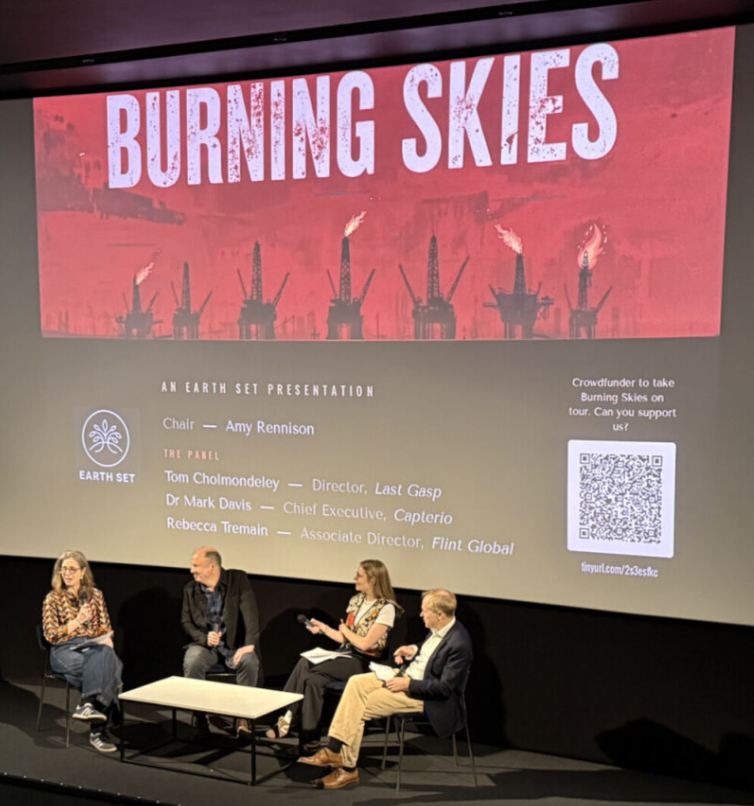
Amy, Tom, Rebecca and Mark discussing the films and methane flaring
June 2026
Featuring: Tom Cholmondeley, Director of Last Gasp and curator of Burning Skies; Rebecca Tremain, Associate Director, Flint Global; Mark Davis, Founder & CEO, Capterio
Venue: Chiswick Cinema
Earth Set's first Film Night brought together five short documentaries exploring the oil and gas industry from very different perspectives. Screening at Chiswick Cinema, Burning Skies took the audience from Iran and Iraq to North Dakota, Grangemouth and the North Sea, combining striking cinematography with stories of workers, communities and the consequences of extraction.
The evening concluded with a panel discussion focused on methane flaring, the subject of Tom Cholmondeley's documentary Last Gasp.
The Films
Tom's curation brought together five films spanning different countries, decades and viewpoints, each illuminating a different aspect of the oil and gas industry.
White Earth (2014) – Directed by J. Christian Jensen
Set against the backdrop of the North Dakota oil boom, the Oscar-nominated documentary follows young people growing up amid rapid economic and social change as the industry transforms the prairie landscape around them.
The Shutdown (2009) – Directed by Adam Stafford
A visually striking short film set around Grangemouth, fearturing the harrowing experience of an industrial explosion at the plant that badly injured and temporarily deformed the screenwriter Alan Bissett’s father, examining the trauma it inflicted on the family.
Offshore (2022) – Directed by Hazel Falck
Following North Sea workers and trade union organisers, the film explores what the energy transition means for the people whose livelihoods have long depended on offshore oil and gas production.
Pouring Water on Troubled Oil (2023) – Directed by Nariman Massoumi
Beginning with Dylan Thomas's 1951 journey to Iran to make a promotional film for the Anglo-Iranian Oil Company, the documentary revisits a pivotal moment in the history of oil, nationalism and political change.
Last Gasp (2025) – Directed by Tom Cholmondeley
The final film, a drama, focused on methane flaring in Iraq, where natural gas associated with oil production is routinely burned.
Powerful shareholder Robert Harper and his teenage daughter Julianna have never faced the truth about his investments until Raad Karim arrives.
The Human Reality of Oil and Gas
One of the strengths of the programme was that it approached the oil and gas industry from multiple angles rather than presenting a single narrative.
Some films focused on workers and trade unions grappling with an uncertain future. Others explored communities living alongside extraction infrastructure, or revisited historical moments that continue to shape today's energy landscape. Together, they painted a picture of an industry that is simultaneously economic, political, environmental and deeply personal.
The films also served as a reminder of the physical scale of modern energy systems. Offshore platforms rising from the North Sea, refinery complexes illuminating the night sky, vast industrial installations stretching across deserts and prairies: these are landscapes that rarely feature in everyday conversations about climate and energy, despite their central role in powering modern life.
What emerged most clearly was a sense that the transition is not simply a technological challenge. It is also a human one. Decisions about energy systems affect jobs, communities, identities and places, often in ways that are far more complex than public debates acknowledge.
Why Methane Matters
While the films covered a wide range of themes, the panel discussion focused on methane flaring, the subject of Tom Cholmondeley's documentary Last Gasp.
For many in the audience, methane was a familiar term but not necessarily a familiar problem. Rebecca Tremain explained why methane has become an increasing focus for policymakers and climate experts. Although it remains in the atmosphere for a shorter period than carbon dioxide, it is a far more powerful greenhouse gas in the near term, making methane reduction one of the fastest ways to slow warming.
Mark Davis then unpacked the mechanics of flaring itself. In many oil-producing regions, natural gas emerges alongside oil. Where infrastructure does not exist to capture, process or transport that gas, it is often burned instead.
The numbers discussed during the evening were striking. Gas flaring generates emissions equivalent to around 500 million tonnes of carbon dioxide every year, more than the UK's annual emissions. Millions of people live close to active flaring sites, meaning the consequences are not only climatic but also local, affecting air quality and public health.
Particularly powerful was the discussion of Iraq, the setting for Last Gasp. The country continues to flare large volumes of gas while also facing energy shortages and importing gas from elsewhere. For the panel, this illustrated the extent to which flaring represents not just an environmental failure but also a missed economic opportunity.
From Awareness to Action
Perhaps the most surprising conclusion of the evening was that methane flaring is not an intractable problem. Unlike many climate challenges, the technologies needed to reduce emissions already exist. The discussion therefore focused less on scientific breakthroughs and more on the practical barriers that allow flaring to persist.
The panel highlighted a number of areas where progress is possible:
Stronger regulation – moving from voluntary targets to clear legal restrictions on routine flaring and venting.
Better measurement and reporting – ensuring companies accurately monitor methane emissions and publicly report them.
Faster leak detection and repair – identifying methane leaks quickly and requiring operators to fix them within defined timeframes.
Investment in infrastructure – creating the pipelines, processing facilities and gas capture systems needed to put associated gas to productive use rather than burning it.
Meaningful enforcement – ensuring that penalties for breaching flaring regulations are significant enough to influence behaviour.
International leadership and standards – building on examples such as Norway, where routine flaring has been tightly restricted for decades, and developing stronger expectations across global energy markets.
What emerged was a sense that this is not primarily a technology problem. It is a problem of incentives, governance and implementation.
If there was a common thread running through both the films and the discussion, it was that energy systems are rarely as simple as they appear from a distance. They are shaped by history, politics, economics and human behaviour. Understanding those realities is often the first step towards changing them.
Many thanks to all the panellists and all those who attended our first film night. Hopefully more to come soon!
