
Volt Rush with Henry Sanderson
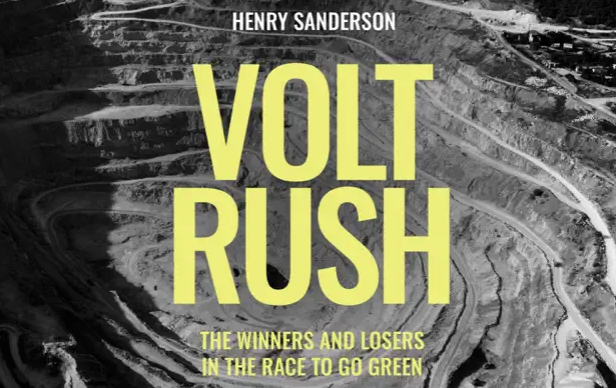
The cover of Henry’s book, Volt Rush
March 2026
Featuring: Henry Sanderson - in conversation with Fiona Howarth for the Earth Set podcast (Episode 5, Season 2) and in a group conversation moderated by Lucy Shaw the Earth Set Bookclub dinner, featuring his book, Volt Rush.
The global energy transition is often discussed in terms of technologies: solar panels, wind turbines, electric vehicles and grid storage. But behind those technologies sits an industrial system that is far less visible: one built around lithium, cobalt, nickel and rare earth elements, and the complex supply chains required to process and manufacture them into batteries.
Over the past two decades, China has come to dominate much of that system. Chinese companies now control large parts of global battery manufacturing, as well as significant portions of the refining and processing capacity that turn raw minerals into battery-grade materials. As a result, the shift to electrification is increasingly intertwined with questions of industrial policy, supply-chain resilience and geopolitical competition.
In Volt Rush, journalist Henry Sanderson traces how this system developed and how China built such a commanding position within it. Rather than a simple story about mining resources, the book reveals a far more complex ecosystem of chemical processing, manufacturing capability, state-backed investment and strategic industrial policy.
China’s battery industry grew out of consumer electronics
China’s dominance in batteries did not begin with electric vehicles. It began decades earlier with consumer electronics. Companies such as BYD and CATL first built their capabilities producing lithium-ion batteries for phones, laptops and other devices. That meant China developed deep expertise in battery chemistry, manufacturing and supply chains long before EV demand surged.
When electric vehicles began scaling globally, China already had the ecosystem e.g. engineers, factories, suppliers and capital, in place. The EV transition effectively arrived on top of an industry China had been quietly building for years.
The real choke points sit in processing and refining
The battery supply chain is far more complex than the headline story about mining. Lithium may be mined in Australia, cobalt in the Democratic Republic of Congo and nickel in Indonesia. But turning those materials into battery-grade chemicals requires complex refining and processing steps. This is where China built much of its strategic leverage.
A large share of global lithium refining, cobalt processing and rare earth separation capacity sits in China. These steps are technically demanding, energy intensive and capital heavy, and they are far harder to replicate quickly than opening a new mine.
In other words, the most important parts of the supply chain often sit downstream, not at the point of extraction.
Industrial policy mattered
Another theme running through the conversation was the role of long-term industrial policy.
China supported its battery and EV industries through a combination of subsidies, market incentives and coordinated industrial strategy. Domestic EV demand was encouraged early, creating a home market large enough to support scaling manufacturers. Meanwhile Western economies largely left battery manufacturing to global markets and often viewed mining and processing as environmentally or politically difficult sectors to support.
The result is a global industry where China now controls large parts of the manufacturing ecosystem.
The supply chain behind clean tech is energy intensive
One of the paradoxes discussed in the episode is that the technologies designed to decarbonise the economy rely on supply chains that are themselves extremely energy intensive. Producing battery materials can involve roasting ores at very high temperatures, chemical processing and large amounts of electricity. Much of that processing has historically taken place where energy is cheap and industrial policy supportive.
As the energy transition accelerates, a new question emerges: how do we decarbonise the infrastructure required to build clean energy technologies themselves?
The West is now trying to catch up
Governments across Europe and the United States are now responding with a wave of industrial policy aimed at rebuilding domestic battery ecosystems. Subsidies for gigafactories, incentives for critical mineral supply chains and new trade policies are all part of an attempt to reduce dependence on Chinese manufacturing capacity. But building a full supply chain, from mining to refining to manufacturing, takes time, expertise and enormous capital.
Catching up will not happen overnight.
Henry’s book offers a fascinating look at how energy systems, industrial strategy and geopolitics are becoming increasingly intertwined — and how the clean energy transition is as much about materials and manufacturing as it is about technology.
🎧 You can listen to the full conversation between Fiona Howarth and Henry Sanderson on the Earth Set podcast https://podcasts.apple.com/gb/podcast/volt-rush-how-china-won-the-battery-race/id1845861615?i=1000755523513
Volt Rush is available to purchase at the Earth Set Bookshop: https://uk.bookshop.org/shop/earthset
