
The Fractured Age with Neil Shearing
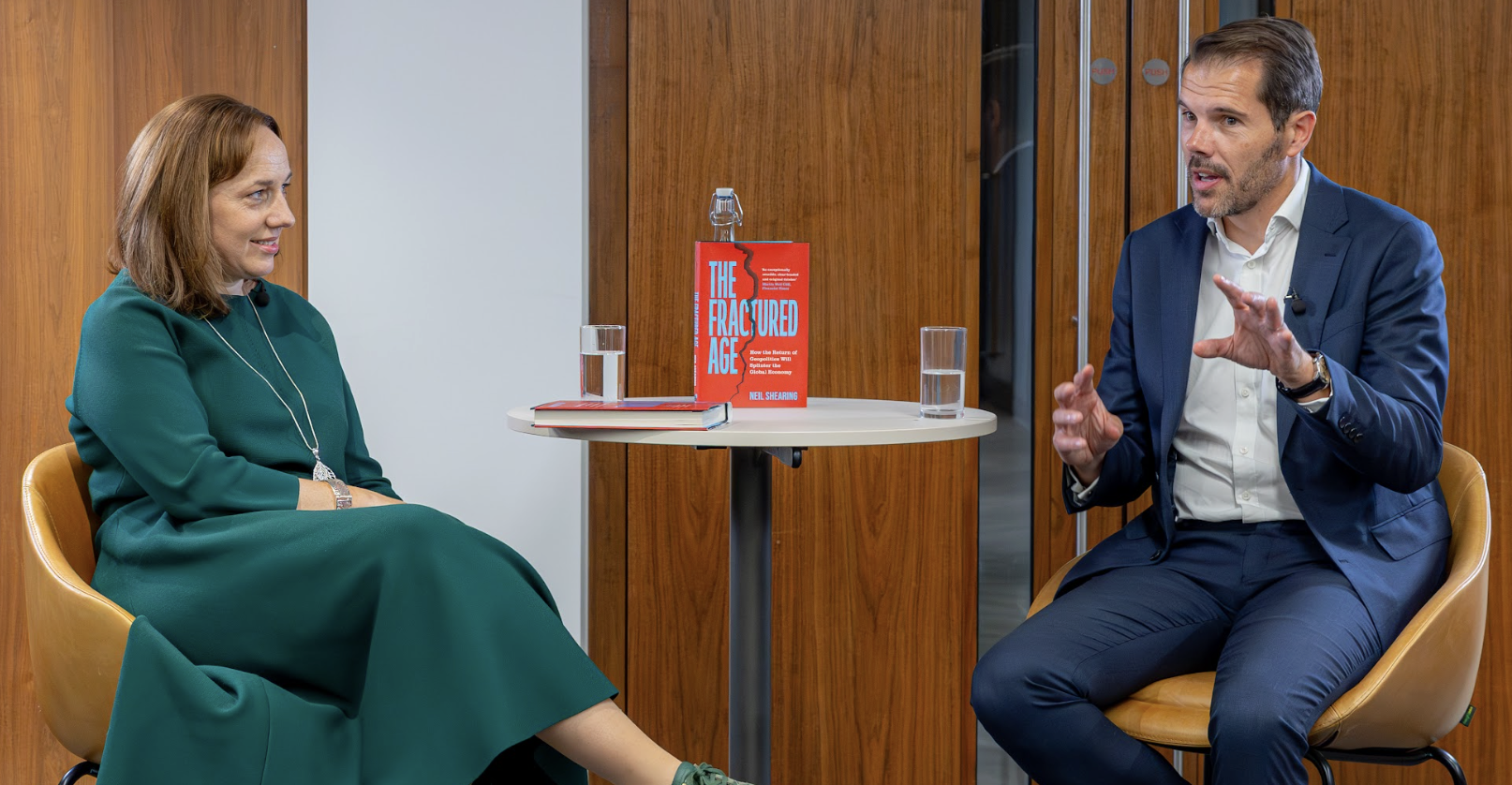
Fiona in conversation with Neil Shearing
November 2025
Featuring: Neil Shearing, Group Chief Economist at Capital Economics
What happens to the green transition when the world stops cooperating?
That was the underlying question running through our recent Earth Set evening at Bain’s London office, where Fiona Howarth sat down with economist and author Neil Shearing to discuss his new book, The Fractured Age and what a rapidly fracturing global economy means for climate, technology, and the future of growth.
This was not a discussion about abstract geopolitics. It was about supply chains, batteries, chips, rare earths, and the uncomfortable reality that the technologies needed for decarbonisation are now deeply entangled with great-power rivalry.
From “deglobalisation” rhetoric to economic reality
Neil began by explaining the genesis of The Fractured Age. During the first Trump administration, headlines were full of talk about deglobalisation, tariffs, and a return to the 1930s. Yet when Neil and his team at Capital Economics looked at the data, something didn’t add up.
Trade volumes were still rising. Capital flows remained high by historical standards. Migration numbers were not collapsing. The story being told politically wasn’t visible in the numbers.
What was changing, however, was more structural, and more enduring: a deepening rivalry between the US and China that is now forcing the global economy apart. Not a clean break, but a gradual fracturing, with other countries increasingly pushed to take sides.
That rivalry, Neil argued, is now the defining force shaping global economics; more than tariffs, elections, or short-term political cycles.
Two economic models, one unstable balance
A central theme of the evening was the stark contrast between the Chinese and Western economic models.
China saves heavily, invests heavily, and consumes relatively little. The US and UK do the opposite: low savings, low investment, high consumption. The result is persistent trade surpluses in China and deficits in the West - and a vast accumulation of overseas assets by China, now estimated at around $9 trillion.
Those assets show up everywhere from property in London and New York to infrastructure across Africa, Latin America, and Southeast Asia, increasingly formalised through the Belt and Road Initiative. While this investment has delivered real benefits, such as ports, railway and power, it has also created debt vulnerabilities and a powerful form of geopolitical leverage.
Every Chinese asset, as Neil put it, is someone else’s liability.
Chips, minerals, and why Taiwan matters
If there was one moment where the room collectively leaned forward, it was the discussion on semiconductors.
Chips, Neil argued, are a foundational technology. They don’t matter because of what they are, but because of what they enable: EVs, grids, AI, defence systems, industrial automation. Today, around 90% of the world’s most advanced chips are manufactured in Taiwan, using tools from US allies like the Netherlands and Japan.
That concentration makes Taiwan not just a geopolitical flashpoint, but an economic fault line. Even a blockade - short of invasion - would send shockwaves through the global economy, including the energy transition.
The lesson was sobering: the climate transition is no longer just about emissions and innovation. It is about geopolitical resilience.
The green transition’s hardest trade-off
One of the most candid parts of the discussion came when Neil addressed a tension many governments are quietly grappling with.
China is the global leader in green technologies: batteries, solar panels, EVs. If European governments are serious about meeting climate targets, some level of reliance on Chinese technology is unavoidable.
The real questions are:
How much reliance is acceptable?
Where are the red lines?
How quickly, and at what cost, can domestic capacity be built?
These are not questions with easy answers. But pretending they don’t exist is no longer an option.
Neil warned against simplistic narratives, whether about full decoupling or blind faith in markets. Instead, he argued for a more pragmatic approach: targeted industrial strategy, long-term capital, and clear decisions about which technologies truly matter.
Why this conversation matters now
What made this Earth Set evening distinctive was its tone. This was not alarmist, nor was it complacent. It was an attempt to think clearly about a world where cooperation is harder, climate deadlines are tighter, and economic assumptions forged in the 1990s no longer hold.
As Neil noted, the greatest risk may not be fracturing itself, but poorly managed fracturing — where alliances fray, policy lurches, and long-term investment gives way to short-term politics.
For anyone working at the intersection of climate, finance, technology, or policy, The Fractured Age offers a rigorous and unsettling framework for thinking about what comes next.
🎧 Listen to the full Earth Set Podcast episode:
https://www.earthset.co/podcast-collection/the-fractured-age-what-uschina-rivalry-means-for-the-planet
📘 Read The Fractured Age — available via the Earth Set Bookshop, supporting independent bookshops:
https://uk.bookshop.org/shop/earthset
Going forward, all authors featured on the Earth Set Podcast and at Earth Set events will have a place in our Bookshop — because serious conversations deserve serious reading.
