
The Pragmatic Climate Reset with Michael Liebreich
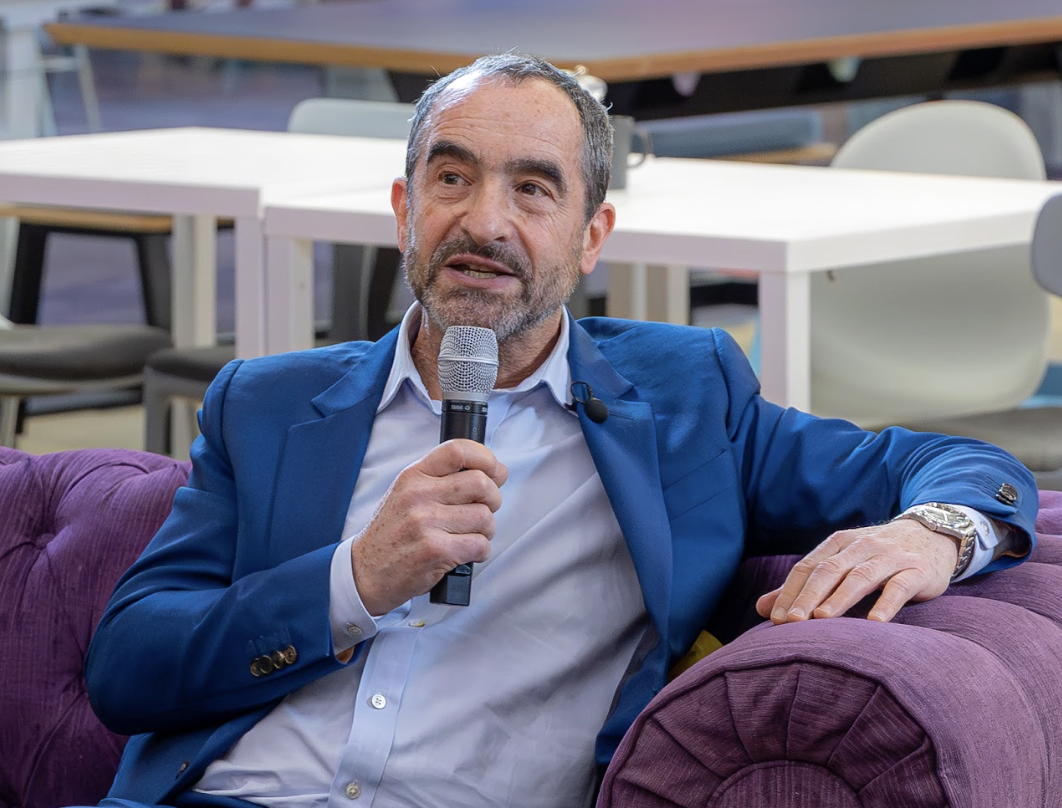
Michael in full flow in front of the audience at Octopus HQ
December 2025
Featuring: Michael Liebreich, founder of BloombergNEF, co-managing partner of EcoPragma Capital, and host of Cleaning Up.
Our final Earth Set event of 2025 brought a sold-out audience to Octopus HQ for a wide-ranging, frequently provocative conversation with Michael Liebreich. The discussion centred on Michael’s recent essay series, The Pragmatic Climate Reset, but ranged far beyond it: from COP and UK energy policy to electrification, hydrogen, grid design, AI-driven power demand and the political economy of the transition.
Why a “Pragmatic Climate Reset”?
Michael began by explaining why he felt compelled to write the Reset essays now. Over the past year, he argued, the public narrative around climate has swung sharply. Where once the dominant tone was urgency and impending catastrophe, much of the mainstream media, particularly following Donald Trump’s re-election, has moved towards scepticism or outright dismissal: claims that the transition is stalled, purely additive, or simply impossible.
The first Reset essay responds directly to this. Its core argument is that the transition is happening, and at scale. Clean energy is not merely being layered on top of fossil fuels: in many sectors and regions it is structurally displacing them.
The second essay is more deliberately uncomfortable. Michael argues that continuing to anchor global climate politics to targets such as 1.5°C or net zero by 2050 - without credible delivery pathways - risks undermining the transition itself. In his view, unrealistic targets distract from the practical task that actually matters: building clean energy systems fast enough to outgrow demand.
COP: what it can, and cannot, do
Michael was critical of the way COP has evolved, though not of its existence. He described it as a forum that has become too large, too unfocused, and too burdened with agendas that sit far beyond what a voluntary international process can realistically deliver.
In his framing, COP is best understood as a signalling and diplomatic mechanism, not a binding delivery engine. Expecting it to drive infrastructure build-out, land-use reform, or national industrial strategy risks disappointment and misallocation of effort. He argued for a sharper focus on mitigation and hard adaptation, and far greater realism about where real decisions are actually made.
Clean Power 2030 and the problem of purity
UK policy, particularly the government’s Clean Power 2030 target , came under close scrutiny. Michael’s critique was not anti-renewables, but anti-misprioritisation. With the UK already approaching 80% clean electricity, he argued, the marginal cost of pushing rapidly towards near-total purity rises steeply, especially when grid constraints are unresolved.
His central point: moving electricity from 80% to 95% clean delivers far less emissions impact than using that electricity to electrify heat, transport and industry. In his view, policy should tolerate small residual emissions in electricity generation if that accelerates system-wide decarbonisation.
The “myth” of the Dunkelflaute
One of the evening’s most memorable sections tackled the Dunkelflaute - the dark, windless winter period frequently invoked as proof that renewables cannot underpin a modern energy system.
Michael acknowledged the phenomenon exists, but stressed its scale: typically one to two weeks a year. Letting a 4% edge case dominate the design of the entire system, he argued, is both irrational and politically convenient for those opposed to the transition. For those rare periods, he suggested, limited use of unabated gas is entirely acceptable, given the overwhelming benefit of decarbonising the remaining 96%.
Electrification first - and hydrogen in its place
Electrification emerged as the clear through-line of the evening. Michael argued forcefully that many sectors are being distracted by hydrogen where direct electrification is cheaper, faster and already viable.
Heat pumps, electric heating, EVs and industrial electrification, he said, are inevitable - and policy should reflect that inevitability. Support mechanisms should align with real-world replacement cycles (such as boiler scrappage), rather than trying to force premature or economically irrational change.
Hydrogen, in his view, has a role, but a narrow one: in genuinely hard-to-abate sectors, industrial feedstocks, and possibly aviation and shipping fuels. Treating it as a universal solution risks slowing the transition rather than accelerating it.
Grid design, pricing and constraints
Michael also addressed grid constraints and the growing cost of curtailment, arguing strongly for locational pricing. Without better price signals, he warned, the UK risks locking itself into a system where clean power is built in the wrong places, paid not to operate, and ultimately resented by consumers.
While acknowledging the political difficulty of reform, he was blunt: no credible alternative has been proposed that resolves rising constraint costs without more intelligent pricing.
Looking ahead to 2026
The conversation closed with a look ahead. Michael expressed cautious optimism, not based on hope, but on arithmetic. If clean energy continues to grow faster than overall energy demand, the transition will happen.
The challenge, he argued, is not technological possibility but political discipline: staying focused on what works, resisting distraction, and avoiding the temptation of purity tests and silver bullets.
🎧 The full conversation is available now as Episode 8 of the Earth Set Podcast:
The Pragmatic Climate Reset — with Michael Liebreich
Our thanks to Michael for an exceptionally open and rigorous discussion, to Octopus for hosting, and to everyone who joined us for a fitting close to the Earth Set year.
